
Commercial flat roof repair in Sarasota FL is usually simple and affordable when the problem gets caught early. It gets expensive when it does not. Low-slope roofs in Sarasota, Bradenton, Lakewood Ranch, and Venice rarely fail all at once. They fail slowly, at the same handful of spots, while the space below stays dry enough that nobody investigates. By the time water shows up on the floor, the insulation has been wet for months.
That gap between when a roof starts failing and when someone notices is where most of the money gets wasted. This guide covers what actually breaks on commercial low-slope roofs in this climate, how to tell what stage you are in, and how to make an honest call between repairing and replacing.
Why Flat Roofs Take a Beating in Florida
Low-slope roofs are not a design flaw. They are standard on warehouses, retail centers, restaurants, medical offices, and light industrial buildings because they cost less to build and handle rooftop equipment easily. The issue is that Florida puts more stress on a roof than almost anywhere else in the country, and a flat roof has fewer natural defenses than a pitched one.
Three forces do most of the damage.
Water With Nowhere to Go
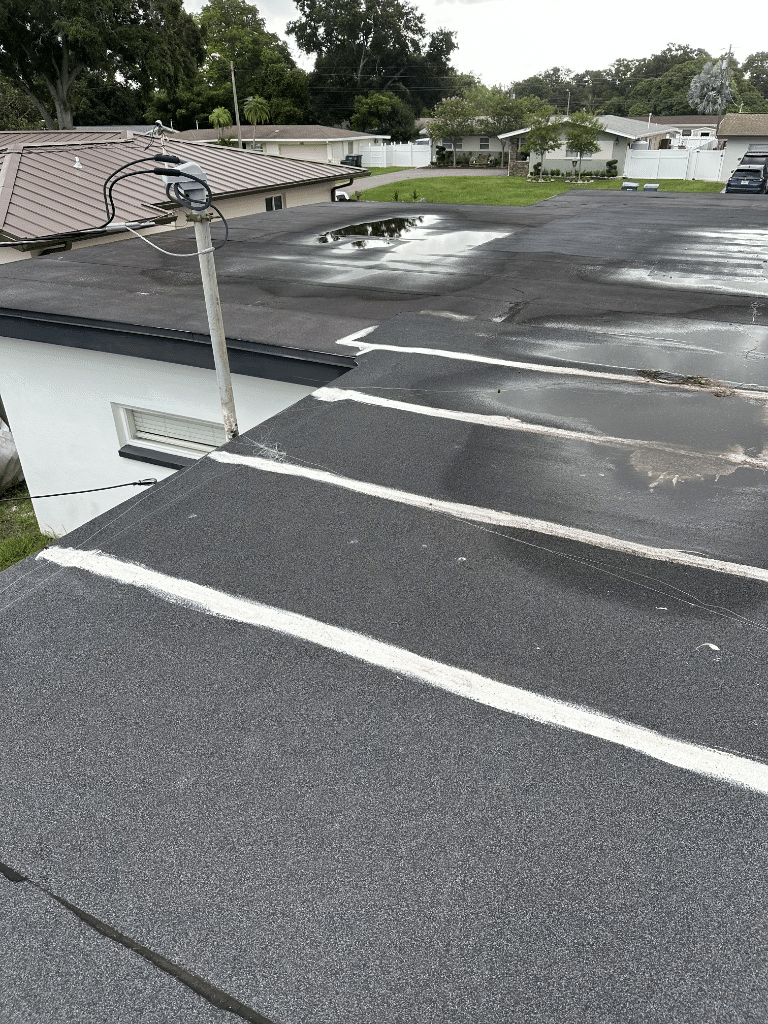
A flat roof is not actually flat. It is built with slight slope toward drains and scuppers. When the drainage path clogs or the deck sags, water sits. Ponding accelerates membrane breakdown, adds structural load, and turns a minor seam defect into an active leak.
Anyone responsible for a low-slope roof should know how to prevent flat roof ponding water by inspecting drains and scuppers regularly. It is the most preventable failure mode in the region.
Heat and UV
Sun exposure degrades roofing membranes year round, not just during storm season. Daily thermal cycling expands and contracts the roof, working seams and flashings loose over time. Heat, UV, and humidity accelerate roof degradation in Florida, meaning a system rated for 20 years in a milder climate can lose several of those years here without proper care.
Wind and Storm Debris
High winds lift membrane edges and drive water sideways under flashing. Debris punctures. A storm that leaves no visible damage can still loosen fasteners and open seams that leak weeks later.
None of this is dramatic on its own. It compounds.
The Failure Points Behind Most Commercial Roof Leaks
Roof membranes almost never fail in the open field. They fail where something interrupts them. When a leak shows up in a Sarasota commercial building, it usually traces back to one of five places.
Penetrations and Curbs
Every pipe, vent, conduit, and HVAC curb is a hole in your roof that has been sealed. Sealant is not permanent. Pitch pans dry out and crack. Curb flashing pulls away as equipment vibrates. On a typical commercial building, penetrations account for a large share of all leak calls.
Seams and Laps
Single-ply membranes like TPO and EPDM are joined at seams. On modified bitumen, laps are torch applied or adhered. Seams age faster than the field because they carry the stress of thermal movement. A seam that has separated a quarter inch is invisible from the ground and fully capable of soaking your insulation.
Perimeter Edges and Parapets
Wind uplift concentrates at the edges. Coping caps loosen, edge metal separates, and the wall to roof transition opens up. Parapet walls are also a common source of water intrusion that gets misdiagnosed as a roof leak when the real problem is the wall.
Drains and Scuppers
Blocked drainage does more than cause ponding. It backs water up above the flashing height at the drain, which is the one place the system was never designed to hold standing water.
The Deck Itself
Long-term saturation rots wood decking and corrodes steel decking. Once deck damage is present, you are past a simple patch.
Warning Signs You Can Catch Before the Leak
The visible leak is the last symptom, not the first. If you know what to look for, you get months or years of notice.
- Standing water 48 hours after rain, which points to a drainage or slope problem
- Bubbles, blisters, or ridges in the membrane, which suggest trapped moisture or adhesion failure
- Soft or spongy spots underfoot, meaning saturated insulation below the membrane
- Cracked or missing sealant at penetrations and pitch pans
- Rust streaks or corrosion on metal panels, fasteners, or edge metal
- Interior staining, especially near exterior walls or under rooftop equipment
- Rising cooling costs with no other explanation, which often means wet insulation has lost its R-value
Small issues that look cosmetic have a way of becoming capital expenses. There is a clear pattern in how small commercial roof problems turn into major repair bills, and it almost always starts with something a facility manager noticed and planned to deal with later.
Commercial Flat Roof Repair in Sarasota FL: Repair, Restore, or Replace
This decision costs owners the most money when they get it wrong, and it goes wrong in both directions. Replacing a roof with ten good years left wastes capital. Patching a roof that is structurally compromised is worse, because you pay twice.
When Repair Is the Right Call
- Damage is isolated to specific, identifiable areas
- The membrane across the rest of the roof is still in reasonable condition
- Insulation below the damage is dry, or the wet section is contained and can be cut out and replaced
- The roof has meaningful service life left relative to its expected lifespan
- There is no widespread deck deterioration
Targeted flat roof repair is the right answer more often than most owners assume. A well-executed repair on a sound roof buys real years, not a few months.
When Restoration or Coating Makes Sense
- The roof is aging but fundamentally intact, with no saturated insulation
- Seams and flashings can be reinforced rather than replaced
- You want to extend service life and cut cooling load without a tear-off
Coatings are not a cure for a failing roof, and any contractor who sells them that way is selling you a future problem. Applied over a sound substrate, they perform well, adding a fresh waterproofing layer while cutting energy costs through improved reflectivity. This is one of the more cost-effective options available to an owner with an aging but stable roof.
When Replacement Is the Honest Answer
- Insulation is saturated across large areas
- The deck is compromised
- The membrane is at or past its service life and leaks keep appearing in new locations
- Repair costs over a few years would approach replacement cost
- You are planning building improvements that depend on a sound roof anyway
The real test is cumulative. If you are calling for commercial roof repair three or four times a year in different spots, you no longer have a repairable roof. Work through the repair versus replacement decision with a contractor who will give you a straight answer instead of a low bid.
What Repair Looks Like on Each System
The right approach depends on what you have up there.
TPO. Thermoplastic single-ply is repaired by heat welding new material over the damaged area. Clean welds need clean, sound membrane. Aged TPO becomes hard to weld reliably, which is a signal the system is near the end of its usable life.
EPDM. Rubber membranes are repaired with adhered patches and seam tape. EPDM handles heat well, but seams and flashings are its weak point.
Modified bitumen. Repairs involve heat welding or torch applying new plies. These systems are durable but need attention at laps and terminations. Knowing when modified bitumen roofs should be repaired, coated, or replaced keeps owners from tearing off a roof that had a decade left.
Built-up roofing. Older BUR systems are still common on Sarasota commercial buildings. They are repairable, but the layered construction hides moisture.
Spray polyurethane foam. SPF systems are repaired by cutting out damaged foam, refilling, and recoating. Their advantage is that they can often be renewed in place rather than replaced.
Metal. Low-slope metal fails at fasteners, seams, and rust points. Metal roof work in this market often means restoration rather than replacement, since a structurally sound deck can be recoated and sealed for a fraction of tear-off cost.
Maintenance Is the Only Thing That Actually Controls Cost
Reactive roofing is expensive roofing. Every dollar spent on scheduled maintenance displaces several dollars of emergency repair, interior damage, and lost operating time.
A workable program looks like this:
- Two professional inspections per year, before and after storm season
- Quarterly drain and scupper clearing, more often under tree cover
- Post-storm inspections after any significant wind or hail event, even when nothing looks wrong from the ground
- Documented repairs with photos and dates, so you can see whether problems are recurring or spreading
- A budgeted line item, not a contingency
Florida’s dry season is the practical window for this work. Scheduling inspections, repairs, and coatings during the dry season means the work gets done properly and the roof is ready before the next storm season instead of during it. A structured maintenance plan built for Florida conditions turns a reactive expense into a predictable one.
The payoff is measurable. Proactive maintenance is the main lever available to extend the lifespan of a commercial roof.
What Drives the Cost of a Commercial Roof Repair
Nobody can quote a commercial roof repair accurately without seeing it. A firm number over the phone is a guess. What moves the price:
- Scope and location of damage, including whether wet insulation has to come out
- Roof system type, since some materials cost more to repair than others
- Access, meaning height, equipment staging, and whether the building stays operational
- Deck condition, the variable most likely to change the number after work begins
- Code and permitting requirements, which in Florida are not optional
Owners setting budgets should understand the general range of roof repair costs for commercial buildings before collecting bids, if only to recognize a number that is too good to be true. The lowest bid is frequently the most expensive option once you pay a second contractor to fix the first one’s work.
Warranty terms matter as much as price. Plenty of owners find out after a failure that coverage excluded the exact condition that caused it. Troyer backs the workmanship with a 10-year guarantee, and a manufacturer warranty on coatings is available when requested, with terms that vary depending on the system chosen. Read the document and understand how commercial roofing warranties actually work before you sign.
Choosing a Contractor Without Getting Burned
Florida has a persistent problem with unlicensed and transient roofing operators, and commercial buildings are a target because the contracts are larger. Verify the license, verify the insurance, and confirm the name on the contract matches the name on the license. Asking the right questions of a roofing contractor before you sign filters out most bad actors in one conversation.
Beyond credentials, look for a contractor who will tell you not to replace your roof when it does not need replacing. That answer costs them revenue. It is also the clearest signal you will get about whether they plan to be your roofer for the next fifteen years or just this quarter.
Frequently Asked Questions
How long should a commercial flat roof last in Sarasota?
It depends on the system and the maintenance history. Single-ply membranes typically run 15 to 25 years, modified bitumen similar, and properly restored metal can go longer. Florida heat, UV load, and storm exposure pull the low end of those ranges down. Consistent maintenance pulls them back up. Neglect can cut a roof’s life close to half.
Can a flat roof leak be repaired without replacing the whole roof?
In most cases, yes. Isolated leaks at penetrations, seams, or flashing are routinely repaired without a tear-off. Replacement becomes the better option when insulation is saturated across large areas, the deck is deteriorating, or leaks keep appearing in new places.
How often should a commercial roof be inspected?
Twice a year at minimum, plus after any major storm. Buildings with heavy rooftop equipment, tree cover, or a history of leaks should be inspected more often. An inspection is inexpensive relative to what it prevents.
Is ponding water always a serious problem?
Water that clears within 48 hours after rain is usually acceptable. Water that sits longer indicates a drainage or slope issue and needs to be addressed. Persistent ponding shortens membrane life, adds structural load, and turns minor defects into active leaks.
Are roof coatings a real solution or just a patch?
Applied over a sound roof with dry insulation, coatings legitimately extend service life, improve waterproofing, and reduce cooling costs. Applied over a failing roof with wet insulation, they trap the problem. The condition of the substrate decides whether a coating is a smart investment or wasted money.
The Bottom Line
Commercial flat roof repair in Sarasota FL is not complicated when it is handled early. These systems fail in predictable places for predictable reasons, and the warning signs are visible to anyone who knows where to look. What makes flat roofs expensive is not the Florida climate. It is the habit of waiting until water is coming through the ceiling.
Get the roof inspected twice a year. Keep the drains clear. Fix small things while they are still small. And when replacement is genuinely the right call, make that decision with real information instead of a low bid and a handshake. If you need an honest assessment of what your roof needs now versus what can wait, Troyer Commercial Roofing handles flat roof repair for commercial buildings throughout Sarasota, Bradenton, Lakewood Ranch, and Venice. We also serve Nokomis, Osprey, Port Charlotte, and North Port.