
How a Florida Warehouse Avoided Buying a New Roof Thanks to a Commercial Metal Roof Restoration
When a Florida warehouse struggles with ongoing roof leaks, many assume a whole new roof is the only solution. In reality, that decision can lead to unnecessary cost, disruption, and downtime for the business.
In this case study, we’ll show how our team here at Troyer Commercial Roofing used a commercial metal roof restoration protocol to solve persistent issues, eliminate leaks, and extend the life of a Sarasota facility’s roof, without the need for a full roof replacement.
The real problem behind this warehouse roof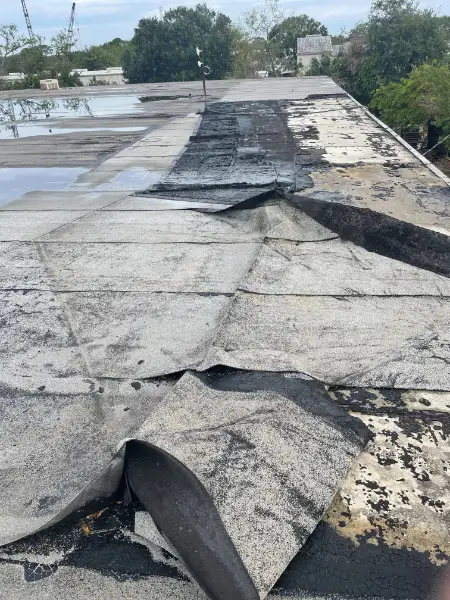
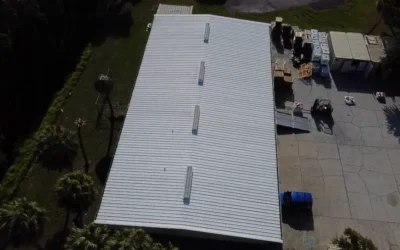
The building in this project belonged to Trademark Metals Recycling, a commercial operation based in Sarasota, Florida. The property featured a metal warehouse roof covering approximately 4,000 square feet and had been exposed to years of heat, humidity, and weather-related wear.
Over time, several issues developed that are common in aging metal roofing systems:
- Leaking skylights that allowed water into the building
- Rust forming across sections of the roof
- Damage from tree limbs impacting the roof surface
These problems had persisted for around four years, gradually worsening and creating ongoing disruption for the business. When Trademark Metals Recycling’s plant manager, Brad Cody, reached out to Lester, leaks were no longer isolated. They were occurring across multiple areas of the roof, making the whole problem difficult to manage with temporary fixes.
For facility managers, this situation is all too familiar. Metal roofs are durable, but they rely on components like fasteners, seams, and protective coatings to remain watertight. Once those elements begin to fail, small issues can quickly turn into widespread leaks.
In Florida’s climate, this process often accelerates. Frequent rain, high humidity, and intense sun exposure can break down protective layers, allowing rust to develop and water to penetrate vulnerable areas such as seams and skylights.
At this stage, many businesses assume roof replacement is the only viable option. However, as this project shows, that isn’t always the case.
Why a new roof wasn’t the right choice
When faced with widespread leaks and visible roof deterioration, the most common assumption is that a full roof replacement is the only reliable fix. For many Florida businesses, that assumption can lead to a significantly higher upfront cost than necessary.
In this case, replacement was considered. The roof had rusted sections, failing skylights, and multiple leak points, all signs that typically raise concerns about long-term performance. However, after assessing the structure, we determined that the roof was still a strong candidate for repair and restoration.
The key issue wasn’t structural failure. It was surface-level deterioration, including compromised seams, fasteners, and protective coatings. These are exactly the types of problems a commercial metal roof restoration is designed to address.
Choosing to replace the roof entirely would have introduced several challenges:
- Higher cost: Full replacement involves material removal, disposal, and new installation, all of which significantly increase project expenses
- Operational disruption: For an active warehouse, replacement can interrupt daily operations, create safety concerns, and extend project timelines
- Unnecessary waste: Removing a roof that still has structural integrity often means discarding materials that could otherwise be restored and protected
Instead, restoration offered a more practical, convenient, and cost-effective solution. By repairing damaged areas and applying a high-performance coating system, the Troyer Commercial Roofing team could resolve the leaks, prevent further deterioration, and extend the roof’s lifespan.
This approach is especially relevant in Florida, where many commercial metal roofs fail at the surface level long before their underlying structure is compromised. In these cases, restoration allows businesses to avoid the expense and disruption of replacement while still achieving long-term performance.
For facility managers evaluating their options, the key takeaway is this: a leaking roof doesn’t automatically mean it needs to be replaced. The right assessment can reveal opportunities to restore rather than rebuild.
The roof restoration process
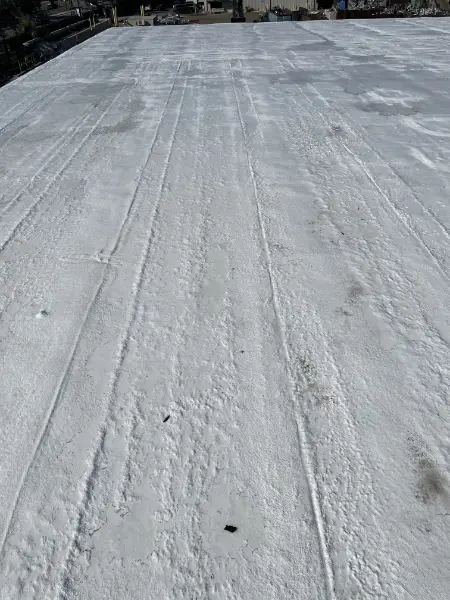 Once it was clear that restoration was the right approach, the Troyer Commercial Roofing team began work on the project in January 2023, completing the restoration within the same month using a focused, efficient process.
Each step was designed to address both the visible damage and the underlying causes of the leaks, ensuring long-term performance rather than a temporary fix.
Step 1: Cleaning and surface preparation
The process began with a thorough pressure wash using Rust Off cleaner to remove oxidation and prepare the surface. This step is essential for successful restoration of any metal roof, as it removes dirt, oxidation, and contaminants that would otherwise prevent coatings from bonding properly.
Without proper preparation, even the best coating system can and will fail prematurely.
Step 2: Securing and repairing the roof structure
Next, the team addressed mechanical and structural issues across the roof, which included:
- Tightening all loose fasteners to stabilize the metal panels
- Replacing sections of metal that had rusted through
- Installing new skylights to eliminate active leak points
This stage ensures the roof is structurally sound before any coating system is applied.
Step 3: Treating rust and reinforcing vulnerable areas
To stop further deterioration, we applied a rust-inhibiting primer (Conklin Encase) across the roof. This creates a protective barrier and prepares the surface for the coating system.
At this stage, the Troyer Commercial Roofing team began using the Conklin MR System, a proven commercial roof coating system designed specifically for metal roof restoration. Each product in the system is designed to work together as part of a fully integrated roofing system.
We reinforced critical areas that are more susceptible to leak pressure, such as seams, using Spunflex fabric embedded in Benchmark basecoat. This step is especially important on metal roofs, where seams are one of the most common sources of leaks.
We also sealed every fastener individually using Kwik Caulk to prevent water penetration at these small but vulnerable points. We find individually sealing around screws and similar penetrations is the most effective way to ensure a watertight result.
Step 4: Completing the coating system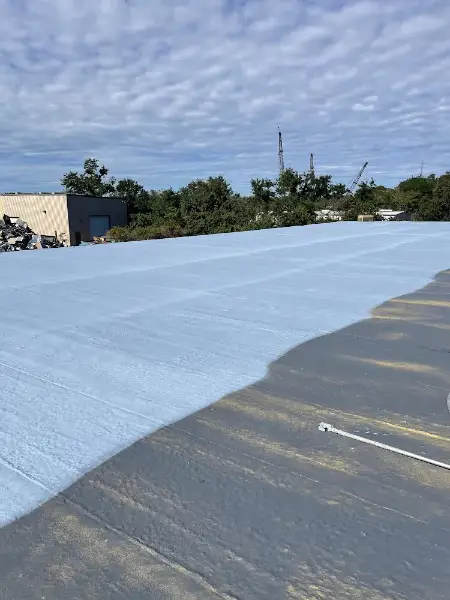
With repairs, preparation, and reinforcement complete, the Troyer Commercial Roofing team applied the final layers of the Conklin MR System to fully seal and protect the roof.
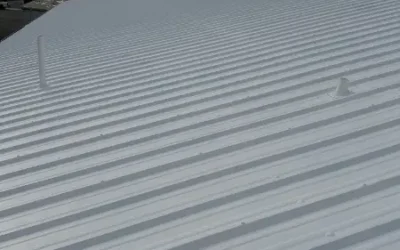
This included the application of a high-performance PUMA XL topcoat, which creates a seamless, fully adhered membrane across the entire surface.
The topcoat plays a critical role in the system by:
- Sealing the roof against water intrusion
- Reflecting heat to reduce surface temperatures
- Protecting the underlying layers from UV exposure and ongoing wear
The result is a continuous, durable roofing system designed to perform reliably in Florida’s demanding climate.
Why this system works
The Conklin MR System is particularly effective for restoration of commercial metal roofs because it addresses both current issues and future risk and it’s capable of doing so on any size roof.
Instead of relying on isolated repairs, it creates a continuous protective layer across the entire roof. This helps:
- Prevent new leaks from forming
- Slow down or stop further rust development
- Improve energy performance (and reduce the client’s cooling bill) by reflecting sunlight
- Extend the lifespan of the existing roof without a full replacement
For Florida buildings exposed to intense sun, heavy rain, and humidity, this type of system provides a practical and long-lasting solution.
Video: Completing a commercial metal roof restoration with a reflective coating in Sarasota, Florida
The results for Trademark Metals Recycling
After the restoration was completed, the impact on the building was immediate and measurable.
Most importantly, the persistent leaks that had affected the warehouse for years were fully resolved. Instead of managing ongoing water intrusion and temporary fixes, Brad now had a watertight roofing system designed for long-term performance.
Beyond stopping the leaks, the restoration delivered several additional benefits:
- A noticeably cooler interior: Employees reported that the building felt cooler after the project. The reflective topcoat helps reduce heat absorption, which is especially valuable in Florida’s hot climate.
- Extended roof lifespan: By addressing rust, reinforcing seams, and applying a protective coating system, the existing roof was preserved and its service life significantly extended. Had yet more temporary fixes been applied to the roof, it’s highly likely that by now (a little over three years later) Brad would have had no choice but to replace the roof entirely. Instead, he’s got a waterproof roof that should last at least another 17 years thanks to the 20-year warranty on the Conklin products used to restore the roof.
- Reduced maintenance concerns: With seams sealed, fasteners protected, and a continuous membrane in place, the risk of recurring leaks and ongoing repairs was greatly reduced. Brad’s not continuously having to book in a roofer to patch recurrent leaks like he was before.
After the project, Brad shared this feedback:
“Troyer Commercial Roofing did a great job repairing two of our roofs at our business. They were very communicative and receptive to our needs. Also, the price was very reasonable. I would recommend them to other branches of our business,” said Brad Cody, Trademark Metals Recycling.
This feedback reinforces the value of choosing restoration over replacement, not only in terms of performance, but also cost and overall experience.
For businesses operating in Florida, where roofs are constantly exposed to harsh weather conditions, achieving this combination of durability, energy performance, and cost control can make a significant difference over time.
What Florida businesses can learn from this project
This project highlights a key insight for Florida facility managers and business owners. A leaking or aging metal roof doesn’t automatically require full replacement. In many cases, the right restoration approach can solve existing issues while avoiding unnecessary cost and disruption.
So how can you tell if your roof is a good candidate for commercial metal roof restoration?
Signs your roof may qualify for restoration
While every building is different, one of the most important factors that determines whether a roof can be restored or must be replaced is whether the roof’s underlying structure is still sound. If the roof deck and panels are intact, restoration may be a viable option, even in the presence of visible issues like these:
- Recurring leaks in multiple areas, which often leads people to assume replacement is necessary. However, if leaks are concentrated around seams, fasteners, or skylights, a thorough preparation and coating system can often resolve them.
- Visible rust or surface deterioration, since early to moderate corrosion may look serious, but in many cases it can be treated, sealed, and protected as part of a restoration system.
- Loose or failing fasteners, a common issue in metal roofing systems exposed to expansion and contraction, and can typically be corrected as part of the restoration process.
- Widespread surface wear, since when protective coatings have broken down but the underlying structure remains intact, restoration can provide a new protective layer without the need for new metal sheets.
If these issues sound familiar, it may be worth exploring restoration before committing to a full replacement.
Why timing matters in Florida
Florida’s climate makes proactive decision-making especially important. Heavy rain, high humidity, and intense UV exposure can quickly accelerate roof damage once it begins.
Addressing issues early with a restoration system can:
- Prevent small problems from becoming major failures
- Reduce the risk of emergency repairs during storm season
- Help businesses plan and control roofing costs more effectively
Waiting too long, on the other hand, can limit your options and make replacement unavoidable.
The value of a professional assessment
The most important step is understanding the true condition of your roof. What looks like a replacement scenario on the surface may actually be a strong candidate for restoration.
At Troyer Commercial Roofing, our team evaluates:
- Structural integrity of the roof system
- Condition of seams, fasteners, and penetrations
- Extent of rust or surface deterioration
- Suitability for a coating system such as the Conklin MR System
This allows us to recommend a solution that aligns with your building, budget, and long-term goals.
For Florida businesses looking to reduce costs while protecting their property, commercial metal roof restoration offers a proven alternative to replacement. The key is identifying the opportunity early and working with a contractor who understands how to execute it correctly.
A smarter way to solve costly roof problems in Florida
For many Florida businesses, a leaking or aging roof can feel like a costly problem with only one solution. As this project shows, that isn’t always the case.
Through a carefully executed commercial metal roof restoration, Troyer Commercial Roofing was able to eliminate long-standing leaks, improve building conditions, and extend the life of an existing roof, all without the expense and disruption of full replacement.
For facility managers and business owners, the key is understanding the difference between surface-level deterioration and true structural failure. When the underlying roof system is still sound, restoration can deliver long-term performance, cost savings, and peace of mind.
If your building is showing signs of leaks, rust, or ongoing wear, the next step is getting a clear assessment of your options. Troyer Commercial Roofing works with Florida businesses to evaluate roof conditions and recommend practical solutions based on long-term value, not just short-term fixes.
Scheduling a professional inspection now can help you determine whether a commercial metal roof restoration is the right approach, before minor issues turn into costly replacements.